Showing posts with label General. Show all posts

Friday, June 17, 2011

The rising sun

The sun had not yet risen when Vandana woke. It was the day of the month she looked forward to the most. She took the tola and walked to the cow shed silently. Her husband hardly got any sleep after the factory they sold their cotton to started offering double shifts. He now tended to the farm in the mornings and worked in the plant in the evenings.

As she milked the cow, she planned her day. First, she had to cook lunch for her husband and children, and then walk to the cooperative in the next village to buy more seeds. She would reach home only by noon.

The second half of the day was what Vandana was excited about. On the first Saturday of every month Srinivas Sahib came to the village. Srinivas Sahib was from the city, from the government bank. Every month, he would sit with the women and listen - whether the borrowers were paying money back on time, the rains, the crop, almost every other thing that happened in the village since the last meeting. A year back, when the first such meeting had taken place, none of them dared to speak. After about half an hour, finally succumbing to Srinivas Sahib’s persistence, Gayatri mentioned the lack of rains, and all of a sudden, everybody wanted to say something! Nowadays, everyone looked forward to the meetings, questions prepared and ideas thought about. If not anything, at least they could talk to someone who was from the city.

Vandana clearly remembered the time when Srinivas Sahib had first come to the village. When he suggested that families come together with their savings and lend to villagers in need, he was laughed at. What were the moneylenders there for? How patient he had been. The moneylender was looting them, he said. The bank would lend as much money as the villagers brought together, and they would charge a cost far lower than the moneylenders. Why would they want to go to the moneylenders when they could help each other? Then the second shock. Women, elected by the villagers, would be in charge of the money. They would hold meetings and decide who could borrow how much! Her husband, like many others, was livid with rage. Who will look after the house? Was Srinivas Sahib saying that the men in the village could not take care of their women and children? Vandana, like all the other women, had stared at Srinivas Sahib with
uncertainty. She had always felt she could do something more than the chores at home, but this? She was scared. Srinivas Sahib had again been patient. How will you manage this money when you are working in the factory, he asked. She manages your money at home. Let her manage money in the community.

The monthly collections were higher than the previous month yet again. The monsoon had been good. Srinivas Sahib had promised that at this rate, they could apply for more money from the bank! She looked up to see Pavithra, her eldest daughter, walking out of home, yawning. More money meant they could finally afford fertilizers for the cotton!

Vandana smiled. The sun was rising.

Wednesday, December 29, 2010

Before & After

BEFORE

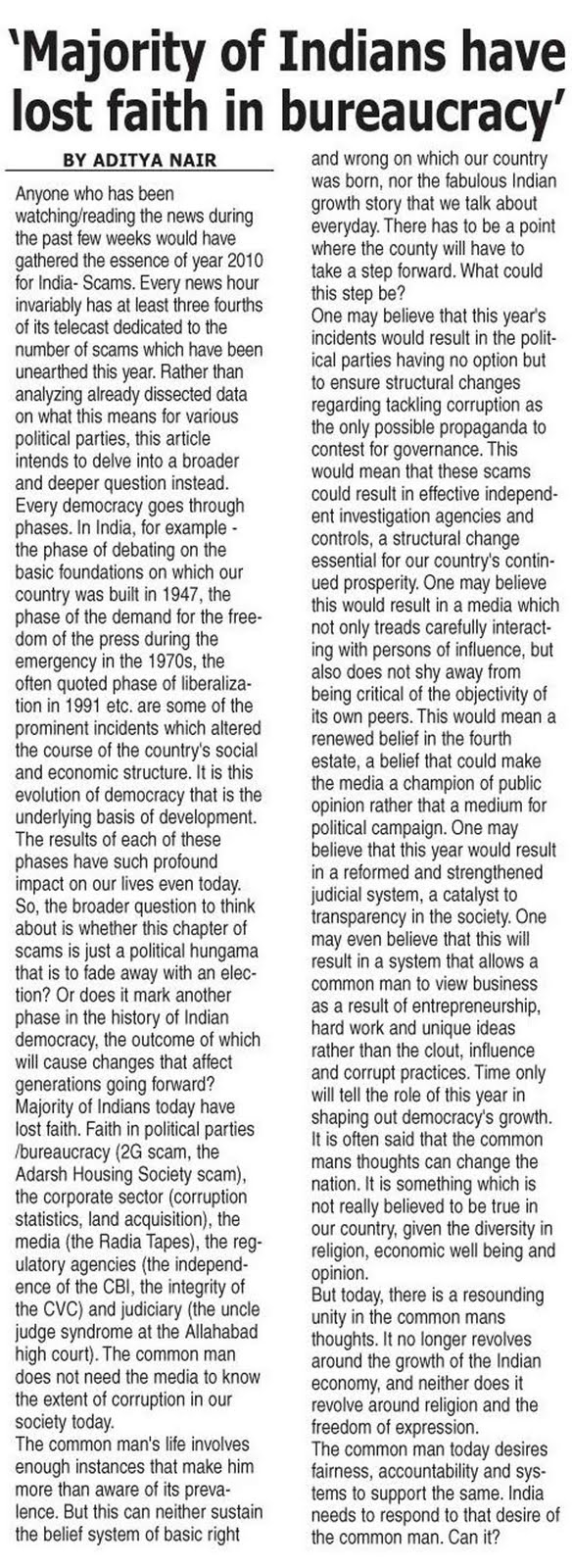
Anyone who has been watching/reading the news the past few weeks would have gathered the essence of year 2010 for India- Scams. Every news hour invariably has at least three fourths of its telecast dedicated to the number of scams which have been unearthed this year. Rather than analyzing already dissected data on what this means for various political parties, this article intends to delve into a broader and deeper question instead.

Every democracy goes through phases. In India, for example - the phase of debating on the basic foundations on which our country was built in 1947, the phase of the demand for the freedom of the press during the emergency in the 1970s, the often quoted phase of liberalization in 1991 etc. are some of the prominent incidents which altered the course of the country’s social and economic structure. It is this evolution of democracy that is the underlying basis of development. The results of each of these phases have such profound impact on our lives even today. So, the broader question to think about is whether this chapter of scams is just a political hungama that is to fade away with an election? Or does it mark another phase in the history of Indian democracy, the outcome of which will cause changes that affect generations going forward?

Majority of Indians today have lost faith. Faith in the political parties/bureaucracy (2G scam, the Adarsh Housing Society scam), the corporate sector (corruption statistics, land acquisition), the media ( the Radia Tapes), the regulatory agencies ( the independence of the CBI, the integrity of the CVC) and judiciary ( the uncle judge syndrome at the Allahabad high court). The common man does not need the media to know the extent of corruption in our society today. The common man's life involves enough instances that make him more than aware of its prevalence. But this can neither sustain the belief system of basic right and wrong on which our country was born, nor the fabulous Indian growth story that we talk about everyday. There has to be a point where the county will have to take a step forward. What could this step be?

One may believe that this year’s incidents would result in the political parties having no option but to ensure structural changes regarding tackling corruption as the only possible propaganda to contest for governance. This would mean that these scams could result in effective independent investigation agencies and controls, a structural change essential for our country’s continued prosperity. One may believe this would result in a media which not only treads carefully interacting with persons of influence, but also does not shy away from being critical of the objectivity of its own peers. This would mean a renewed belief in the fourth estate, a belief that could make the media a champion of public opinion rather that a medium for political campaign. One may believe that this year would result in a reformed and strengthened judicial system, a catalyst to transparency in the society. One may even believe that this will result in a system that allows a common man to view business as a result of entrepreneurship, hard work and unique ideas rather than the clout, influence and corrupt practices. Time only will tell the role of this year in shaping out democracy's growth.

It is often said that the common mans thoughts can change the nation. It is something which is not really believed to be true in our country, given the diversity in religion, economic well being and opinion. But today, there is a resounding unity in the common mans thoughts. It no longer revolves around the growth of the Indian economy, and neither does it revolve around religion and the freedom of expression. The common man of India today desires fairness, accountability and systems to support the same.
India needs to respond to that desire of the common man. Can it?

AFTER # 1
Indian Express
Dated Dec 30th, 2010


AFTER # 2


Tuesday, September 14, 2010

Choosing the right pill

“Hey, is the presentation ready?”

Maysh looked up to see his boss staring at him questioningly. The presentation was ready, but that wasn't what he was thinking about so deeply . He had been acting like this for the past couple of months, silent, introspective. His boss had taken him to the side the other week and asked him everything was alright. Was it? Of course it wasn’t, that wasn’t the question. The question was whether he could do something about it.

A year back, Maysh was just another smart college kid who managed to score a job at Abode- the home for high iq intelligentsia. He was excited about joining. Truth be told, he did go a little over board acting like a smartass in front of his not so lucky batchmates. But it was worth it, or so he thought.

Don’t get the wrong impression, work was fun. It was challenging – requiring intellect, charisma and the stuff. Moreover, getting the recognition and the money was like a kick he had never felt before. It wasn’t like he felt he was wasting his life, and he got to meet a really interesting people too. After the initial honeymoon period too, nothing changed. That was the problem.

Wait! How was it a problem? He couldn’t explain it. He just didn’t want to do the same thing anymore. He first tried what anyone would. Party harder after work! Didn’t help. He then tried ignoring it. Then tried increasing his workload. Nope.

Something was just wrong! The thought of going back to that cubicle answering your boss’s question “Is the presentation ready?”, seemed to make him want to just leave the place. Not that his boss wasn’t a kickass fellow (The story of the night of 24th October will come in a later post).

So he started looking around. What was he good at? Software,Math of course!Hmm…talking, I guess…? Cracking jokes? What could he do differently? Along with work he took a course to learn MCing, one on the stock market, another in marketing.

It felt good. It felt like he was heading somewhere (and boy! Did the Mc thing pay off! Talk about wild nights!! Hmm…more about that in the post of 24th October). Slowly, things started making sense. He sometimes felt like he was trying to do a wannabe Neo in real life (the blue pill or the red ?).

He wanted to do something on his own. Of his own. He wanted to create something, something of value. Of course, he also wanted to make money, but that wasn’t the point. The point was he was ready to sacrifice the money he had into something that might not see the light of day. What a rush!

“Is the presentation ready, Maysh?”. His boss looked concerned.

“Sorry Ren. Yeah, its ready. Listen, Ren, there is something I need to talk to you about…”

Monday, September 13, 2010

Fortune at the bottom of the pyramid


While there has been much discussion about the Lat Prof. C.K.Prahlad's fortune at the bottom of the pyramid, my post has nothing to do with it. The fortune Im talking about is not from the perspective of the business opportunity that lies within the lower middle class, its about the employment opportunity that lies with everybody today.

Last year, when my college placements were going on, there were quite a few moments when we would all go “whoa!” over a huge package offered by a company. This trend seems to only get better and better as the years pass on. But once I started working, I observed few other things as well which were as surprising. Unlike our parents generation, the kind of remuneration offered by companies today is not really dependent on how many people work under you or how big a team you lead. In some firms, there are employees who earn more than the top man/woman, even though they are in a department of the same organization.

It goes without saying that I was quite intrigued. So I tried to find out a little more. A friend of mine, who works in a techie organization with world renowned practices shed some light on it. She told me that in her company, people were assigned grades according to how they perform. But going up a grade does not have anything to do with whether you get into a managerial role, or shift departments to get more exposure. For example, if there is a person who is a very good engineer and wants to be involved in coding work only, it doesn’t mean her growth prospects are low. She could move up grades being a software engineer. This means that there could be a software engineer who is a grade 10 working in a team under a project manager who is a grade 9.

To me, this is the ultimate form of a free organisation, where people do what they love and in turn enhance the productivity of the organization as a whole. I remember the famous Peters Princple which basically says - “One always gets promoted to the level where he becomes incompetent”. This system is the perfect solution to the principle. What it also means is that today, an employee can actually take a decision on what she wants to do and how long she wants to work. With the introduction of flexible working hours and telecommuting, she can even decide when she wants to work. Talk about choosing your own work-life balance. It also means that today, she could decide to work in the same position she is in for the rest of my life and earn her fortune, even if it’s her first job right out of college – right at the bottom of the corporate pyramid.

With the lean organization becoming more and more popular, and outsourcing becoming a phenomenon, it makes a lot more sense to pay more for executives from day 1. The idea that Lean organisations need fat people is becoming a popular one, primarily because its expensive to replace them and also because they could eventually specialize in that job year after year and become an invaluable asset at that level. So I think more “whoa!” jobs are definitely for the taking in the coming years.

Sunday, September 12, 2010

Work in Progress


It has been just some time since I have started work. Hardly a few months back I was a graduate fresh out of college, ready to take on the world with my brainstorms. If you would look around, none of them seem to have reached any of you yet :-)

Things haven’t really been as fast paced and exhilarating as I expected yet. But today, when I think about it, slowly and steadily a number of things have changed. The most important thing work has brought in my life is the same as any major incident does – perspective.

I came to work with a number of aspirations. Noting really concrete, except the cliche overdose of ambition. The first lesson I learnt at work was that enthusiasm cannot be faked. It is something I am still learning. The only way to do something really well is being interested,genuinely interested, and that crucial factor really does change the way you work. So it seems that the only solution to that is to always do what excites you.

But the second lesson I learnt was that work is not fun. It seems like a contradiction with the first lesson. No matter how glamorous a profile sounds, the bottom line is that when one has to go day in and day out doing it, the charm wanes off. But the beauty of it is that the only solution is to accept from the very beginning that work isn’t fun. That it isn’t fun for anybody, no matter what they say. So, when you expect nothing, you enjoy every good thing that comes your way. With that outlook, you only keep looking for interesting things you can possibly do within the things available to you.

There is so much to learn out there, its simply overwhelming. Another thing I learnt is that there always will be quite a large number of people smarter than you. But over the long run, does it matter so much? After going through a zillion profiles of distinguished people on the net (yep, I do get distracted easily at work!), the one thing I can say with reasonable certainty is that there are just too many successful people out there. Which, I think, means that if you can stick in there, stay interested and put in the effort, sooner or later you are going to start getting things right. There just cannot be so many brilliant people in the planet. Therefore, most must be going through the old fashioned way of putting in the effort and doing things that interest them.

Here, at least in our generation, we are a market that rewards specialists rather than generalists. Having a well rounded personality is not really such a big necessity to succeed. If you are good with people, there is a job cut out for you. The same applies to those who are good with numbers but hate people. Of course, there are careers which require both qualities. But the point is that there are careers which don't. The problem only arises when you seek to be someone whose qualities you neither have and neither want to develop. Then, there will always be a mismatch. Figuring that out, that is, my own limitations vis a vis what I aspire to be, is something I am far from figuring out...

Seems like I have my work cut out for me (for now) after all :-)

Saturday, June 20, 2009

An Update on Life

It has been ages since my last post...something which I deeply regret. A lot of things have taken place in the past year, which I assume would have changed me and my perspective. I regret not blogging regularly so I could look back figure the change in thinking. Anyway, better late than never I guess.

Most people have a fascination towards the world of finance nowadays. I too am a part of that lot. And to satisfy my curiosity, off late I have been trying to discover the secret knowledge that everyone my age is looking to seek - to have an idea of what it is that these movers and shakers actually do. And have I? To some extent yes. But the funny part of discovering things is that you always want to know more... and there are more questions to ask than answers to give, aren't there? And so it is these new set of questions that I'm now pondering over.

The world of finance is undoubtedly complicated, exciting, highly mathematical and relationship based at the same time and very, very interesting. The risks taken are enormous, the gains and losses even more so. From the professional setup to the high profile meetings, from the millions of dollars to the bitter competition, it really is a kick for those who are of that mould. But in the past few months, there is one thing that seems missing in the whole system. And the something is empathy.

Now dont get me wrong, I love what I see. There is something about this world that just draws you in. I cant explain it, but I sure as hell can feel it. And don't assume that I'm saying the place is devoid of ethics either. Its a highly ethical industry. Well, at least the professional ones whom we associate the financial industry with are. But being ethically right sometimes does not mean being morally right. Being ethically right may not be being sympathetic or empathetic either.
Though not clearly, I now can relate to why most successful people turn toward philanthropy at the later stages of their life. The speeches by Bill Gates and the story about high profile CEO's quitting their jobs and turning to non-profit organizations make some sense now.

There are people who are ambitious and there are people who have a passion to do something for the society. And then there are those who are both. Isn't it a real challenge when your job doesn't satisfy both these aspects of your personality? I'm not talking about a situation where the job requires to do something against your principles and the likes. That would make things back and white, far too easy. The question arises when you end up in a job that is challenging, extremely satisfying, something you love to do and have a bright future with but doesn't involve other aspects of your personality. For example, say you have an amazing job that is really stimulating and challenging and you love it but it does not have an impact on the society per se, which really matters to you. Or you are doing a socially meaningful job but it doesn't have the future or career path or remuneration that you are comfortable with. I think these are the questions that will matter the most a couple of years down the line when we get out of college life and the first couple of months of earning and spending recklessly. I guess people don't really want a single thing in life. Each one of us has a certain expectation of himself, and would like to be satisfies that he is able to tap his potential to the maximum. But there are hardly such tailor made jobs and even so, then comes the question of taking the risk to make that jump from one job to another. Sometimes it may involve shifting fields, taking risks like never before.

Another thing that I noticed, something which is quite an obvious statement to make, is that theory is not the same as practice. But another observation that I made is that the difference between theory and practice can be made up for in many ways. In case it isn't, it may result on one not being successful or being just a little successful. In some cases it is made up with assumptions, based on historical data. "This had happened before so it may most probably happen again". More often than not it is made up for by learning, through books, keeping aware or through relationships(professional or personal). But the most successful and beautiful way to make up for this difference is to use all these methods and combine it with a not so common thing called creativity. And I guess most of us will agree to the fact that the more we seem to acquire knowledge and grow old, the more we also feel that we are losing our innate creativity at the same time. Its a peculiarly funny problem to which there seems to be no perfect solution. One just hopes to keep a little bit of both and make up for it with another substitute known as experience.

I have a feeling this post is going to seem like a really vague one to all of you, but its something to ponder about. I hope all of you can relate to it with your lives as well. It may make way for some really interesting introspection and discussion.

Saturday, January 17, 2009

Music to my ears

Have you ever traveled in a really noisy bus. Though initially the noise pisses you off, after a while you tend to find a sort of rhythm in the noise the bus is making.

I think that is the basis of music.Patterns!
The first thing that attracts us to music is something distinct that we can identify it with. Some people love basic chords, some have a fascination for crazy guitar solos, some are suckers for an amazing voice hitting a really high note. Each one of us may have different tastes, but all the interests have one thing in common. We love a certain pattern and that is the prime reason for us liking a particular kind of music.

Why do some people like rock? I think initially everyone takes a little bit of time to adjust to rock from soft music because it takes time to identify the pattern. It takes time to get used to finding the beautiful sequences that lie buried in the heavy base and distorted chords. But once you get it, the respect you have for the inherent beauty of the creation is so overwhelming that you want to listen to more and more music of the same genre. There are some songs which get more and more addictive as you hear them, just because each time you do there is some pattern you have never heard before. The depth of the music overwhelms you, and you feel that you can associate and identify with these patterns in a manner that no one else can. That it is something tat only you and the creator of the song can understand, and that means so much. You are so thrilled at being able to identify these patterns and connect with them so much that you start un-liking the previous music you used to admire as a by product of this new found enthusiasm. And then there are those who love heavy metal, thrash metal ,grunge metal etc. The heavier it gets, the tougher the pattern is to recognise.
But the beauty of the entire thing is that it just isnt about identifying hidden patterns. Its about the music you love to listen to. Its not about whether your ears are capable of bearing the harshest music. Its about whether you enjoy it.

Whats music to ones ears and noise to another is just a matter of perspective. But this perspective is a good indicator of you, of what you are, how you feel and what you believe in. How else could one explain wy people grow out of some genre's of music and get enticed into some others as the grow. I believe it is true when one says that you can tell a lot about a person from the music he listens to. But the problem is that how you judge the person would depend a lot on the kind of music you love as well.

And so I have evolved from loving Backstreet Boys to Linkin Park, from Metallica to Iron Maiden, from Black Sabbath to Rasmus, From 3 doors down to Jimi Hendrix, from Pink Floyd to Red Hot CHilli Peppers, From Dire Straits to Bob Dylan.And I feel Ive only just begun.......

Thursday, December 18, 2008

Calculating the worthiness of an individual


(Please read this most only if you like math enough to understand it and hate it enough to bear my interpretation of how it can be used)


Let us consider a situation where a person's value (I know it’s a vague term) varies from 0 to 1, where 0 stands for a guy with no morality and is despicable while 1 stands for the ideal morally conscientious guy.
Every decision a person takes would involve levels of morality and immorality, hence varying from 0 to one. Let us say we frame the system in such a way that 1 would stand for a morally correct decision where both the person as well as the persons he is affecting from the decision gain from it and all the parties are morally satisfied with the decision as well.
Once I have defined 1 in this manner, then obviously a possibility arises of a decision carrying a value of more than 1, when the person taking the decision gains nothing from it but the remaining parties do. If one thinks with this logic, if the person makes a loss, then the value would be the greatest.
The trick of playing this game called LIFE would be :
1)To have the ability to make these decisions
2)To have the ability to make decisions to affect many people hence increasing the value of the decision.
3)To make decisions so as to increase the overall value of the net effect of all the decisions at the end of the game.

The net effect could be calculated as

N.E = D1*D2*D3*D4*.........Dn
where n is the total number of decisions taken in one's lifetime.

There are certain traits that one can derive from this above formula.

1) If the value of the decisions is consistently less than one, N.E tends to 0 (for large n)


2) The only possibility of boosting N.E is if the value of D is greater than 1, i.e: when the person taking the decision gains nothing from it but the remaining parties do.


There are certain factors which affect the value of D
1) Due to empirical evidence, it is assumed that most people want to have a large value of n.
Also, most people are also influenced to a great extent by the effect of D rather than the value of D, i.e: the impact of D on the parties concerned rather than whether the value of D is lesser or greater than 1.
Also, there is a correlation with the impact of D with the consistency of D lying between 0 and 1
It has been noticed that when D lies between these limits, the impact of D tends to be stronger. However, this is true only during a certain stage of N, i.e: from the beginning to a certain value.

Considering all these factors, man seems to have evolved with time to use a time tested strategy of playing the game called LIFE.
He starts not bothering much about the value of D, but with the impact of D. Of course, there are aberrations here and there, however this is the overall trend.
At a certain n (the point is primarily dependent of how powerful the impact of his D's are, but n is generally greater than n/2); man takes a shift and starts gradually changing the value of D's to greater values. However, these too, are calculated to ensure that the decline in the impact of the D’s is not too great.
When the n is close to its upper limit( man is aware of this because there would now be considerable periods of time where he would not be able to take any D's as he would by busy with other activities, like staying alive), the value of increases greater than one significantly.

The general trend that is observed is that despite this, N.E is less than 1
However, as man relies on evolution and improvisation, most new generations just try to find the optimum points where they choose to increase the value of D. Some succeed most don’t.

Saturday, December 6, 2008

Terrorism and our response to it

I was in my friends room studying for my end-semester exams in the middle of the night when I heard of some gang war taking place is in Mumbai. Then I heard something about shots being fired in the Leopold Cafe and the Trident. With my father’s office being just next to the Trident, alarm bells started ringing in my head. Only when I confirmed the safety of my parents and close friends did I come to know about the extent of how bad things really where. I couldn’t contact a friend of mine because the mobile phone service seemed to have been jammed but did receive a reply to my message which was this :
“All of us are okay. We had good for a movie near VT station, heard the gunfire and ran home”
This message told me many things, the most blatant of all the absurd normality that the word “gunfire” seems to have in the sentence. I guess I am freaked out even more as all the attacks have taken place in areas where a have lived in the past two years, where my home, my school and friends are. But I guess everyone is agreed on the fact that this is by far the most daring attempts by terrorists on Indian soil.
When the train blasts took place in September last year, the marked difference was that the people responsible wanted to escape. They had a desire to live. That itself can play a huge part in helping the intelligence agencies in foiling many such attempts. But what do you do if they just don’t care what happens to them. I am pretty sure that if I today decide that I don’t want to live and want to take down a lot of people before I go down, I could to a pretty decent job myself. How effective can an intelligence agency actually be in a country as dense, vast and different as India is? I admit I don’t know the kind of technological capabilities they have but I seriously feel it is unrealistic to be expecting much from them.
The point here is not that any one of us could have carried out acts of terrorism easily (though not of this magnitude, of course). The point is that even if we could, we wouldn’t. Because that’s the way our thoughts have been moulded. Talking tough, even acting tough cannot stop terrorism. Only thinking straight can. Even with the Pakistani governments cooperation all that can be done is apprehending those responsible. It will cause no change in the rate at which terrorists are being made out of innocent people. In fact, it may just increase the number. When we talk so much about terrorism in the Kashmir valley, we blatantly ignore the number of outfits that exist in Assam today, primarily because we cannot blame a neighbouring country for it.
And let’s face it; there is no way India can realistically hope to become a developed nation without Pakistan developing alongside. There is just too much history between the two. The more India develops and the more Pakistan faces these problems, the more will be the disparity between the people of the two countries and hence the better the opportunity for jealousy, hatred and terrorism to spawn. I am pretty sure that both the countries would have been playing opposite roles to a great extent of it was Pakistan that was developing the way India is and if it was India which was caught in a myriad of failed dictatorships and corrupt democracies.
I agree that we must be tough in our dialogue with Pakistan and must be firm in our demands and must make sure that the guilty are brought to justice. But I also think that we need to be realistic as to who would actually gain from this whole episode. I does not make any sense for Pakistani forces to be involved in it simply because they have everything to lose from this conquest .However, Pakistani nationals would seem to be the perfect people to brainwash and send to India to carry out these plans if the people behind this atrocious act seek the change in the global attention to the Indo-Pak peace process.
Barak Obama was elected the new president of the USA with propaganda of going and finishing the war on terror where it started, in Afghanistan. He is due to take his seat in the White House early next year. He has repeatedly stated that Pakistan will have to take a strong stance against the war on terror and support USA’s fight against the Al-Qaeda and the Taliban. Under this pressure, the Pakistani troops participating in the war have been steadily increasing in number over the year. It is interesting that this latest terrorist act comes right after Obama is elected President and right before he assumes office. In the ongoing political turmoil, the USA under Barak Obama will no doubt demand Pakistan to put in more troops to help in the war in Afghanistan to convince the world arena of Pakistan’s stance on the war against terror. If Pakistan does not comply, it would seem to the global community that they are siding with the terrorists or playing a balancing act between the two.
If India does not negotiate with Pakistan in a diplomatic manner, Pakistan will have no choice but to respond in kind. After all, it is a weak democratic government in place there after years of dictatorship. If India makes extraordinary demands out of Pakistan which they do not fulfil, the Indian government will be forced to take action in retaliation to the attacks given the elections next year. In case this happens, the world can say goodbye to cooperation from Pakistan on the war against terrorism, and the war against terrorism cannot be won without Pakistan’s aid. Initially, Pakistan will have to regroup its troops to the Indo-Pak border and sooner or later the USA will have to side with India given the global political pressures.
Once that happens, Pakistan will send all its troops as it sees fit and under the intense global political pressure will seek the support of countries and people who would support Pakistan. And finally, this will lead to cooperation with all those forces that it now stands against.
After saying all this, I surely don’t mean to say that we as citizens do nothing. If there is one thing I found stupid after the train bombings, it was the way the radio stations used to proudly comment on the Mumbaikar attitude of never letting anything affect them and the Mumbai spirit which made them get on the same trains the very next day. How stupid can the guys actually be? It’s not the spirit of Mumbai, its the desperation of the people. They have to earn a living for their families and there is nothing they can do but go on the same trains and risk their lives every day. The people who never travel by those trains and attend high class social functions call it “The Mumbai spirit” over cocktails and drinks. It is nothing but ignorance and desperation. If the terrorists want attention, I think its about time we gave them just that. But not by doing the same things that they do and definitely not by just holding the same peace marches that last for a day and lighting the same candles which last for even lesser, but by taking some concrete steps.
Having studied in a lot of schools all over India including Kendriya Vidyalaya, I have a pretty decent idea of the importance value education is actually given in education. It is not even a course that affects one’s percentage. How can one expect a student to take the subject seriously when it does not even affect his/her percentage? Instead of spending ages discussing the names of various party politicians that should be there in the history books, it is this that is screaming for attention. I do not know what we, as individuals can actually do but recently I heard about something called a professional party. The idea behind it is that it would consist of working educated professionals not part of any of the present political parties who want to get into politics to make a difference and are willing to put in the effort. I think it is an amazing cause, which even if not successful will definitely force other parties to rethink their methods of publicising themselves.
I would really appreciate more ideas on what we could individually contribute to make an impact on our united fight against terror.

Sunday, November 2, 2008

Sin City, World and Life

It is 4 o clock in the morning and I have just finished watching all the episodes of the first season of SMALLVILLE in a marathon session.Prior to this I saw a documentary called Zeitgeist(an awesome thought provoking watch about which I intend to write a post soon). If anyone of ou has seen both of them then you would know the stark difference, one a teenage supernatural drama while the other a documentary on mindboggling conspiracies!

While watching Zeitgeist it dawned on me how much we don’t know about the world and how less we try to find out. And then I spent 24 hours watching all the episodes of a thoroughly mediocre television series(Season 1 that is,I plan to start the season 2 marathon tomorrow). And now, finally before I call it a day I decided to just jot down a theory that crossed my mind after this watching spree.

I think at the end of the day, people just do things to derive satisfaction out of it. And this would primarily be based on how we are brought up.For example, Lex Luthor in the series derives pleasure from doing things to prove his Dad wrong while Clark Kent does so from saving people’s lives. But at the end of the day it is the same motive everyone has.

Ethics is based on moral philosophy.It has many definitions and branches but the gist of it is that people must do things that are socially acceptable. Hence, by definition they depend on how the society is at that time.

Today it is considered good to work hard, concentrate on studies, go up the ladder and become something in life. But I don’t think that is actually true. It would be equally acceptable for a person to just get an ordinary job and have an ordinary life as long as he does to derive pleasure from being really successful. I think this is what actually is the cause of why some people are really successful and some people not.

I do not think it is mere coincidence that successful people’s kids generally end up doing decently well. They would be brought up in such a way that the thing that gives them satisfaction is to be successful.The same goes for people who are self made.They are generally brought up in such a way that there is a thirst to do something to change things. It is what satisfies their craving.

So, technically being successful, as the term is used socially does to necessarily mean going up the ladder and becoming someone. One could actually live a successful life by just being normal and living an ordinary life as long as they are conditioned and brought up to be satisfied that way.But the problem nowadays is that it is considered socially unacceptable to have limited dreams and achievable targets.

Coming back to the satisfaction theory, wouldn’t this mean that at the end of the day all of us are just looking for our own kick? Some guys work out and get their six packs to make themselves feel good, while some eat a dozen hamburgers. Some get into drugs, while others get into social service. Yet some of these are considered “good” while some “bad”. This definition of good and bad is obviously dependent on the social environment. A classic example would be how Human Rights were considered sacred in America until the twin tower attacks after which now Homeland Security has the power to arrest, search and torture any person without a warrant. This is a classic example of how “bad” can become “good”.

I do appreciate the fact that we must have certain rules to be followed for a society to become civil. But the basis of these rules has thus far been purely experimental and very bloody ( from whatever history we know). But finally at the end of the day, does it all really matter? I frankly cannot see any purpose in life other than making myself feel happy, whether to me it means making others around me feel happy or just watching a TV series alone in my room. A logical question from here would be that is it is all about satisfaction, then why do we actually even bother to go through anything that causes the opposite.

You are going to laugh when you read where I actually got a lead to the answer to this question – The movie THE DEVILS ADVOCATE (yes, I do watch a lot of movies).See, I believe that that man identified the primary things that actually satisfy him classified them into seven categories namely lust, gluttony, greed, sloth, wrath, envy and pride. The primary cause of why we do go through situations which do not give us pleasure is simply that we want to continuously experience all these sins. But this is where we reach a problem. It would be very tough to balance an equal amount of “sin”. For example, if one indulged in gluttony too much it would affect his indulgence in pride accordingly and hence he would stop and go through the trouble of hard work to rework his pride level. So in the end our entire life would be a task of attaining this equilibrium.

Consider a hypothetical situation where a person is brought up in such a way that the only way he can derive satisfaction is by helping people. Then that will be what he would do. Similarly,if it is by killing people. My point is not how people can be shaped so easily into doing things over the long run, but that either way why would it matter. Both would serve the purpose to the person who is doing it.

This is one of those random posts that are just supposed to be food for thought and has no conclusions. Can’t think of anything more to comment so all I’m gonna say is Good Night.

Saturday, October 18, 2008

Political Debates in India?


During the past three weeks, I had the opportunity of watching the US presidential debates for the first time in my life. What struck me first, was obviously how different the system in the US works as compared with India.


Be it Obama or McCain, both the candidates have very commanding personalities. While McCain has an unbelievable track record, with serving 20 odd years in the Navy, Obama makes up with his razor sharp focus and amazing eloquence and clarity. Even though I would love to see a debate of the Indian prime ministerial candidates in the coming elections, u, it does not seem likely in the near future.Rajdeep Sardesai, a journalist from CNN-IBN whom I admire a lot, has been trying to initiate this culture in India requesting for the same but thus far these has been unsuccessful.


And unsuccessful he has been for obvious reasons. While India boasts about being a secular country, everyone knows that the primary propaganda of all parties is to reach out separately to different communities on the basis of religion. While with the BJP it is the Hindu’s, the Congress uses the idea of equality amongst religions to primarily target the Muslims and other religions. Hence, the absence of a candidate being partial to a particular sect at a debate aired throughout the nation would be catastrophic for its base voters.


The basic problem that is cited is that even when people are uneducated in the USA, there is a common language everyone understands– English. Hence, everyone can follow the debate and arrive at a decision. In India, of the educated, the people in the north speak in Hindi and are primarily weak in English. In the south it is even more divided as every state’s language is different from the others. Of course, there is the obvious solution of translating the debates in various regional languages, but somehow it is simply not considered.


Another aspect that I admire about the system followed in the USA is the focus on the topics to be discussed. The questions put forth by the press are clear, concise and cutthroat, leaving no room for error, while the answers by the candidates are equally eloquent. One of the questions which was put forth in the third debate (Obama vs. McCain) was – “Given the nature and effect of the present economic crisis, by how many years do you think the government can balance its budget with respect to debt?”.When the candidate did not give a number, the moderator quickly pressed, “Are you willing to give a specific timeframe or not?”.The beauty of the discussion was that the entire episode was extremely polite but equally firm and demanding. Is this not democracy at its best?


However, I do not think that having a prime ministerial debate would be of much help in our country just yet. The primary target audience of the debates like these is the educated middle class. The upper classes (who primarily consist of the business class) would already have decided whom they would support as they would have to be associated with politicians in order to thrive in their businesses (as these factors are of utmost importance while being in the business sector in India. For Example: The latest Tata Nano episode).T he problem is that the majority of the people who vote live in these rural areas and are uneducated. And most of the middle class in India do not vote. Hence, the political parties are just taking a logical decision when they use regional influence to obtain the votes of the uneducated. Because it works, and because they are the ones who finally go and vote!


But though the debates will not be feasible for the present elections, conducting them now may be the reason why it will be in the later ones.Debates such as these will be a investment to changing the culture of politics in India. Since the policies towards globalization and liberalization in 1991, the percentage of people shifting from the poor to the middle class is increasing at such a phenomenal rate that one can expect nearly half of India to be in the middle class bracket by 2050. The middle class would vote only on the basis of what they perceive is best for them and the country and would not buy any of the ideologies that are presently part of the political parties. Hence, the political parties will have to change their strategy as well.


But the question is, why not change NOW? The truth is that with the phenomenal growth of the middle class in the past decade, the parties should be implementing the changes right now! But they are not doing so only because the middle class is simply not voting. Ask any college undergrad about his favourite movie and most of them would inevitably name Rang De Basanti. In case of a war (for example: The Kargil War), millions of the youth will line up to stand up for our motherland. But the most important part is standing up not in times of catastrophe and radical change but ensuring that we cause the consistent and gradual improvement that our country always seem to lack. This is the primary difference between our country and developed nations and the Asian tigers. In terms of consistent growth, we have a terrible track record. We so love Sachin Tendulkar and adore the unbelievable hundreds after the 10 ducks but find the ever consistent Rahul Dravid boring (Note: I am referring to the Dravid of the 90’s).We loved the idea of massive reform is 1991 when we were at the brink of the economy’s collapse and had to pledge our gold but were mum for 50 years prior to it when the growth rate was dismal.


I think the press will have a huge role to play to bring about this change. Beautiful ideas like Lead India are definitely good initiatives in this direction. I find it hard to believe that given the number of public and private institutions coming up why has it not been made mandatory for every college undergraduate to compulsorily obtain a voter ID card yet. If discussions on politics are not encouraged at this age then it is very unlikely that one is going to take interest in the development of the nation in the future. Some of the talk shows like “We the People” and “The Big Fight” are amazing ideas but are watched avidly by people in their late 20’s and 30’s.If these shows are held in different colleges with students as part of the audience, different city halls of those cities that have been earmarked by the government to be the metros of the future it would slowly and steadily cause a change.


We are at a very interesting stage in our country’s history. Dr.Abdul Kalam’s dream – Vision 2020 could be satisfied only if decisions like these are taken on the nationwide level. No matter who is the next president of America, there are going to be huge negative impacts on the Indian economy due to the economic crises in the USA (more so if Obama becomes the president, as his plans include taxing huge companies – those that primarily are driving the IT boom in India by outsourcing to us and provide companies with tax reliefs if they employ US citizens).I think this is the kind of climate our country actually needed. With the US and other country’s trying to stabilize their economies, we will have to reduce our dependence on them and start looking at our fundamentals and improve job opportunities and conditions in India to provide for the ever growing Indian workforce. If done properly, I am convinced that this would be the deciding factor on how fast we develop into a superpower.

Tuesday, September 9, 2008

Confusion Says

This is going to come across as one of the weirdest entries read by you,Im sure.I think it would give an in depth idea of the confusion that lies in the minds of the Indian metropolitan youth today.As for the observations on which my deductions are based,the guinea pigs are of course me,my friends and the knowledge gained from couple fo dozen movies on the Indian youth(The sources of information that every urban teen bases all his judgements on)

We are a generation of youngsters deeply inspired by anything that happening around us.Just like any other generation,except that while what was around our parents was poverty and lack of opportunity, what is around us is a dozen avenues and an extremely strong media that makes the dozen seem like a million. We are a generation heavily influenced by movies,music and books.Almost all our judgements are based on them.And as there are so many of each,hence the conflicting ideas and all the confusion.


When Dil Chahta Hai came out, everyone loved the way the new generation was portrayed in the movie - confused,confident and classy.When Lakshya released,everyone critically acclaimed the portrayal of the Indian metropolitan youth to be a confused spoilt but talented(somehow) lot, who have no idea what they want to do in life, but somehow end up luckily finding out what that is and successful pretty soon.


I, being a resident of Mumbai, may not know today what is happening regarding the nuclear deal but sure as hell know which look is being sported by whom and what new brand of clothes that Shah Rukh Khan endorses is.


There is an upside as well as a downside to everything.The downside of a generation brought up in such an environment is pretty obvious and talked about so much that I don’t want to dwell on it here.I am yet to figure out whether any concrete upside exists.I just want to post what I feel about it,because I'm assuming that’s how most of us are feeling.


Everyone of us have seen what it is like to be successful, to be glamorous and to live the good life, thanks to the active(forgive me for the mild word) media that exists in our country today.The extravagance of the rich,the attitude,the class and the "sophisticated" look has been shown so many times on TV that that is just about the only thing we associate with success.Hence, when I think about where I want to be in life a few years down the line, the image of a smart looking corporate dude having a nice drink with all his mates in a swank bar after a week of making sophisticated deals clearly comes to my mind.


What I am not clear on is what exactly it is that I will do to make it happen. What exactly is it that I want to do? What is the purpose of what I am doing(I would like to mention here that this is a question that bothers our generation a lot in comparison to the previous one simply because in their case the answer was pretty starightforward - To get rid of the poverty that surrounds them.I think this dominance of question "WHY" that is being asked by our generation is the prime reason why spirituality is much more popular with the urban youth today than in the yesteryears.We tend to want to know the reason for everything that we do,but dont seem to have any logical answer other than money and fame.)

One classic example of the importance of fame in our life is the fact that jobs which involve glitz and glamour today are the only jobs as sought after as those which are the most paid(and in most cases, both these jobs are not the same unless you are top management).We are a generation which I think is very insecure, looking for acceptance and acclaim from others to be sure of what we are doing.

How many times have each of us heard the line, "Today, you kids are so lucky. There are so many opportunities for you. It is not like how it was for us, where everyone wanted to be either a doctor or an engineer."
But the irony is that the number of engineering and medical colleges in India are mushrooming, and this is not just because of the population explosion. Most of us are too unsure of what we want to do. We are too scared to make a choice. So we end up doing something that makes us socially acceptable and then gain confidence from others appreciation. The one off case of the boy who takes humanities after getting a 90 percent is talked about so much. But no one talks about the 50 percent kid who takes Science with bio because of parental pressure. Isn’t it true that in most cases the people with high marks end up doing science and ones with low marks venture into the “various new opportunities” that we talk about so much today(I know Im generalizing a bit too much here)?Isnt it true that most of the students who venture into these new opportunities are girls and not boys,because taking such a huge "risk" is unacceptable by the boys parents?


To make matters worse, we are not part of a society where going back to study (especially to do your undergraduate education) is socially acceptable due to which one has to choose, irrespective of whether the choice is made by him or his close ones or is just plain guesswork. This is partly because all of us, having seen the fruits of being successful and rich, are too impatient to wait to taste it. The idea of losing a couple of years in the rat-race is catastrophe. What if you have to work under your own friend in case you join late? What if you are not that successful and your mates are rising up the corporate ladder faster than you?I think these are the main questions that influence our decisions today, and I still am not sure whether it is wrong to be asking them. Frankly, why shouldn’t one ask them?

A couple of days back the army came to college to recruit students. It got me thinking. I did a little bit of research on it. With an initial pay of around 5 lakhs(I think it is cash in hand),followed with the free accommodation, transportation etc. a job in the army did sound like an extremely good option(considering my branch’s average salary in college is around 4.5 lakhs.And Im not even mentioning the awesome learning experience,amazing social circle and facilities the army has to offer).But of course, there is a catch. The Short Service Commision requires that one work for a minimum of 5 years before retirement.

5 years! The moment I heard that, I revised my calculations. Assuming I join a private company with a pay package of around 4 lakhs to begin with. Given that I do decently, how far up the ladder would I be in 5 years? Better still, say I work for a couple of years and then do my MBA and enter the industry again. Where would that put me?

In comparision, say I work in the Army for 5 years and then retire and enter the market for the first time. The whole sweet picture begins to crumble. For all the experience that I would have gained in 5 years in the army, would have lost 5 years of exposure to the industry where I want (or rather will) work in for the rest of my life.The quick reward seeking nature of my generation makes this unacceptable to me. (It would be interesting to note here that in this whole discussion, the talk of national pride and stuff doesn’t come in at all)

Chetan Bhagat,in his speech on 30th August,2008 in my college The National Institute of Technology,Calicut(in the event Spitfire 08,conducted by the Literary and Debating Club) mentioned a very astute observation. When one goes to a bunch of kids in Kindergarten and asks, "How many of you draw?" almost everyone raises their hands, irrespective if whether they draw well or not. The point being they are all willing to try. Ask the same question to a bunch of college undergrads. Most will not raise their hands. Doesn’t that mean we are afraid to try?

I don’t exacty know where I am going with this.But this is by far,the most personal post I have written(and I guess the most critical).Hopefully will commence and interesting discussion and be good food for thought.

Tuesday, June 3, 2008

Bit By the Entrepreneurship Bug ?!

Though the primary influence of my thoughts in this post is "Losing My Virginity" by Branson which I'm reading right now,I think the book is just the fuse which only starts the fire which then fuels on the thoughts which were are running vaguely on a persons mind.

In the book,Branson goes to narrate his almost unbelievable life,in which the descisions he takes seem intuitive and succesful so many times that one can easily believe that he is making stuff up or glamourising things.But when I think on a broader perspective,I think that though it would seem extremely stupid to take such intuitive descisions,it seems even more so to the Indian psyhche as we are brought up in a very protected lifestyle where one does not take risks in his her career for the sake of something as minor as creative satisfaction.

Though today,the mindset in India is changing,the actual situation how I see it is somewhat like this.As the salary of the Indian graduate has soared,he/she now can afford to take the risk of actually asking his/her mind previously taboo questions like-"Why am I doing this job?" or "Am I satisfied with what I am doing?" or "Is there something which I want to achieve after all this work?".
In short,the idea of being satisfied of what and why you are doing what you are doing is gaining more importance.In my view,this is the basic motivation that drives a person towards entrepreneurship.

To subsatantiate my point,if one looks at businesses very crudely,there are actually very few NEW businesses which actually start,and that solely depend on some huge scientific discovery.A situation rarely happens where a person develops a new technology,strikes gold,and then starts a business on it and becomes highly successful.What generally happens is that a person sees business' around him,and feels that if he had the opportunity to do things,he would do so in a different way which he sees as better.It is his way of doing things that actually drives the business,wich is what finally makes his business unique in comparision to others.

Today,in India,there are a lot of students who graduate and end up taking high end jobs and then are dissatisfied with it.A huge section of these people are dissatisfied because they don't just want to work doing some meagre job with a lot of hours for a high pay that doesnt satisfy their creativity,and are ready to consider a living that may not give as much return but results in something that they can proudly call their own,which has the stamp of their idea on it.I think this is the very group of potential entrepreneurs in the country.But they fear to even think in that direction,due to two reasons.

1)Due to the whole fear of how risky entrepreneurship is compared to the cushy job which they have right now(which it no doubt is).This,coupled with the system in which they have been brought up makes the jump to entrepreneurship all the more difficult.
2)The lack of education and awareness which makes entrepreneurship seem like a great feat,something which can be done only by the bravest of the brave,of which only one of a million will make it.

I strongly feel that we are heavily influenced with what our parents are.It may be either in the positive or negetive manner,but generally is influenced from what their ideas are.It may happen that a guys father is in a government company doing some boring job due to which he may decide that whatever happens,he is not going to do what my parents are doing.But what generally happens is that he ends up doing a different job,maybe in a different field,in a private company,but essentially she still works for someone else.The "radical" thoughts that influence his descision are apparantly not "radical" enough to change from being an employee to being his own boss.I think this is the primary reason why most Gujrati's are businessmen generation after generation.Its because they are brought up in an environment where starting up a business is not something incredible,not something unheard off and impossible,but something that's repectable but very normal.

The way I see it(I may well be wrong),present potential entrepreneurs consist of people who either have close links with entrepreneurs of the previous generation(like their parents,relatives or close friends) or people who are not very well educated and have not a lot to lose by trying it,or people who are technically extemely sound and use this to their advantage to become entrepreneurs(this would be going the other way round,having the technical ability,developing an idea and then developing entrepreneural ideas in oneself).
There are a huge section of people who are well educated(though not supersmart),come from middle class backgrounds and have no exposure to entrepreneurship but are interested in giving it a shot but just dont have the information on what,how and when.I believe this is the section that has to be addressed,because this is the section that mirrors the conservative Indian mentality of the previous generation.It is assumed someone who is not exceptional has to work for someone else.The more the number of peolle in this section convinced of their capabilities and taking the step towards entrepreneurship,the more the mindset of the Indian educated class will change.


Note:This is an article based purely on the books I have read and from what I have experienced in the different places I have been to,both of which are minimal compared to the knowledge actually required to write a very good article on this subject(as my points are not exactly based on statistics n stuff).Hence,I would really appreciate it if we guys could have a discussion going on this so as to get a good picture.....

Thursday, May 22, 2008

Random Musings

This is just the result of a really boring day and a lot of channel surfing and a mind desperate for some exercise.

a)The Lord of the rings

Real life analogy:

The life of a Smart Bachelor:

Assuming the person is a smart bachelor,there will be numerous people waiting to obtain the ring he possesses but is unwilling to give.He,in turn,takes advantage of this fact and convinces these people to do his bidding.Obviously,he is not to be blamed for it because it is just the ring's effect on him that is making him take this advantage and he is not responsible for what he is doing.

Finally,somewhere along the line,he makes a mistake and loses the ring to another.After which,of course he pays for his mistake as the new ring bearer is more bothered about the ring and other things than the old ring bearer himself.

Solution:It has been observed that these qualtities of neglecting the old ring bearer shown by the new ring bearer reduces greatly if she does not wear the ring for long.Hence,the old ring bearer must provide more new rings to the new ring bearer(which must be necessarily more powerful than the old ring).As long as this is the case,the old ring bearer has nothing to fear.A costly solution though....

How to notice that it is time for a change:When she takes your face in her hands and say "My Precious",carefully notice whether she is looking at you or her hand.You will know what is to be done.

b)The God of Small things

(Going by the title)Lets just say its a really nice attempt by Ms.Roy to sympathis with some people,making them feel that there is a God especially for them.Very honourable...

c)"Not a penny more,not a penny less" by Jeffer Archer

The only thing I can decipher from this title is that the book obviously wasnt written in the recent times keeping in mind the inflation rate.

d)Pirates of the Carribean-Dead Man's Chest

This is news.I didnt know that in the Carribean too,people areinterested in dead men's chests.

Maybe they took a leaf out of Indian Doctors,who are interested in Live as well as dead people,their chests,the vital organs that lie in and around it,and their price in the illegal markets.

Wednesday, May 14, 2008

An Inconvinient Truth


I wrote this one after watching “An inconvenient Truth” … Al Gore’s Documentary
"Its difficult to get a man to understand something
when his slalry depends on his NOT UNDERSTANDING it..."-Al Gore

Its funny how the world works
How in each action ,a consequence lurks
Yet,here we are,at this moment, on oneside,with one cause
And then with the opposite,without so much as a beat or pause

What is ethical,what is not
I do not judge, Im not that lot
What on my mind is just one thing
How the hell does one choose his wing

Is there an idea behind each side
Or do all of them change as regularly as the tide
Should principles resonate in my voice
Or should that too change as time flies

Someone Said…
“The only thing that’s constant is change”
Well,its not that way from what I gauge
Coz from what I gather,some things are same
The politics,the confusion,the shifting of blame
What seems to change is just the odd name
While the rich get richer and maybe some more fame

Its like climbing a mountain cliff
Everyone trying hard to reach that elusive tip {Here,everyone refers to countries}
The ones below trying hard to trail
The “great” ones above,their fading trail
Never once does one stop n stare
No No No…to us the beauty is all too stale.

And yet some hope that things will change
For principals and ideals it’s a war they wage
Takin on one person at a time
Showing us the truth,what we’ve done,our crimes

Will we change,or will we lose
Will we still follow the old ways or finally start to choose
Its not a question of WILL but WHEN,really
Coz we either change or will pay dearly